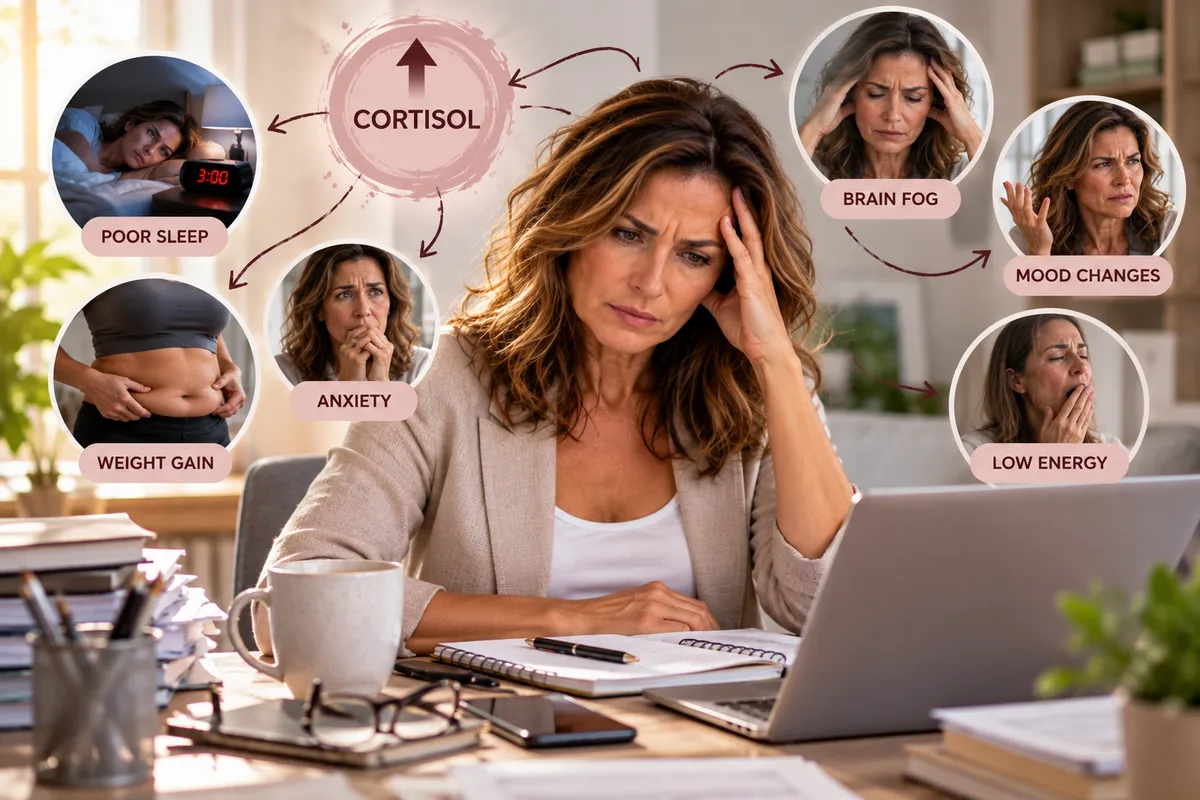
Cortisol and Perimenopause: Is Chronic Stress Making Your Symptoms Worse?
Cortisol and Perimenopause: Is Chronic Stress Making Your Symptoms Worse?
“I’ve always been stressed. Why is it affecting me now?”
I hear this from high-achieving women all the time.
You’ve handled deadlines, demanding jobs, children, relationships, aging parents, travel, financial responsibilities, and a calendar that would exhaust most people.
Stress isn't new to you.
In fact, you may be very good at functioning under pressure.
But somewhere in your 40s or early 50s, something changes.
Suddenly, you don't bounce back the way you used to.
You wake up tired. Your patience is shorter. Your belly seems to be growing even though your eating habits haven't changed much. You wake at 3 AM thinking about tomorrow. You're more anxious. Your heart may race when you're overwhelmed. You crave sugar or coffee just to get through the afternoon.
And then come the hot flashes, brain fog, mood changes, and unpredictable periods.
You blame your hormones.
And yes—perimenopause absolutely changes your hormonal landscape.
But there may be another piece of the puzzle worth looking at:
Your stress response.
Cortisol isn't a “bad hormone” that needs to be eliminated. You need cortisol. The goal isn't to get your cortisol as low as possible.
The real question is whetherchronic stress, poor recovery, and changing hormones are making it harder for your body to adapt.
What Does Cortisol Actually Do?
Cortisol is a hormone produced by your adrenal glands as part of your body's stress-response system.
And despite what social media may tell you, cortisol is not your enemy.
You need it.
Cortisol helps your body respond to stress, influences blood sugar and metabolism, affects immune and inflammatory processes, and follows a daily rhythm that helps support wakefulness during the day and sleep at night.
Normally, cortisol is higher around the time you wake up and gradually declines throughout the day.
Think of cortisol as part of your body's“we need energy right now” system.
You have a presentation?
Cortisol helps.
You nearly get into a car accident?
Cortisol helps.
You need to wake up and get moving in the morning?
Cortisol is involved.
The problem isn't that cortisol rises.
The problem is when your body spends too much time under stress without enough opportunity to recover.
And stress isn't only emotional.
Your body can experience stress from poor sleep, illness, under-eating, excessive exercise, blood sugar swings, chronic pain, inflammation, alcohol, overwork, and many other demands.
This is why simply telling a woman to “lower her cortisol” doesn't tell us very much.
We need to look at what is creating the stress load in the first place.
Why Can Stress Feel Different During Perimenopause?
This is where things get interesting.
Many women tell me:
“I've had a stressful career for 20 years. Why can't I handle it anymore?”
Because you're not living in exactly the same body you had at 30.
During perimenopause, estrogen and progesterone can fluctuate significantly. At the same time, sleep may become less predictable, body composition may change, and hot flashes or night sweats may begin interrupting your nights.
Now imagine adding chronic stress on top of that.
You stay up late finishing work.
You wake at 3 AM.
You start the morning exhausted.
You drink extra coffee because you have an important meeting.
You don't have time for breakfast.
Lunch happens at your desk.
By 4 PM, you're starving and craving sugar.
You force yourself through a workout because you're worried about gaining weight.
Then you get home and start your second shift—family, dinner, emails, responsibilities.
Your body never really receives a clear signal that the day is over.
Then you wonder why you feeltired and wired at the same time.
This isn't about weakness.
It's about accumulated load.
Perimenopause may expose patterns your body was previously better able to compensate for.
Could Stress Be Making Your Perimenopause Symptoms Worse?
Chronic stress can overlap with many symptoms women already experience during perimenopause.
That can make things confusing.
For example, poor sleep can leave you exhausted and hungry the next day.
When you're exhausted, you're more likely to reach for quick energy—coffee, sugar, or refined carbohydrates.
Poor sleep and chronic stress can also affect glucose regulation, appetite, mood, and food choices.
Meanwhile, you may notice:
More abdominal weight gain
Difficulty falling or staying asleep
Waking around 2–4 AM
Increased anxiety or feeling “on edge”
Irritability
Brain fog
Afternoon energy crashes
Sugar or caffeine cravings
Feeling exhausted but unable to relax
Feeling overwhelmed by things you used to handle easily
None of these symptoms proves that you have a “cortisol problem.”
That's important.
There are many possible causes for fatigue, sleep problems, weight changes, anxiety, and brain fog.
But when several of these symptoms show up together in a woman carrying a significant stress load, I think the stress response deserves attention.
This is exactly why functional wellness looks forpatterns rather than blaming one hormone for everything.
You Don't Need to Quit Your Job to Support Your Stress Response
When I tell busy professional women that stress may be affecting their health, I can almost see what they're thinking:
Great. Now I have to eliminate stress too.
No.
Your goal isn't to create a stress-free life.
That's probably impossible.
The goal is to help your body become better at movinginto stress when necessary—and back out of it when the stressful moment is over.
Sometimes that starts with surprisingly small changes.
Eat before you're starving.
Build meals around adequate protein and fiber.
Get outside in natural light in the morning.
Walk after meals when possible.
Strength train without punishing your body.
Look at your caffeine intake—especially later in the day.
Be mindful of using alcohol as your primary way to unwind.
Create a real transition between work and bedtime.
Put your phone down earlier.
Protect your sleep.
And give yourself moments during the day when you are not producing, solving, answering, organizing, or taking care of someone else.
Even five minutes matters.
This isn't about adding another 15-step wellness routine to an already overloaded schedule.
In fact, that's the last thing most high-achieving women need.
It's about figuring outwhich few changes your body needs most.
Your Symptoms May Be More Connected Than You Think
Perimenopause can make you feel like ten things are going wrong at once.
You're gaining weight.
You're waking at 3 AM.
You're exhausted.
You're anxious.
Your periods are changing.
You can't concentrate.
You're craving sugar.
You're irritated by everyone.
And because each symptom seems separate, you may try to solve each one separately.
One supplement for sleep.
Another for hormones.
Something else for energy.
A new diet for weight.
More coffee for fatigue.
Another supplement for stress.
Before long, you're doing more and feeling no better.
This is why I want you to step back and look at thewhole pattern.
Your hormones matter.
Your stress matters.
Your sleep matters.
Your gut matters.
Your blood sugar matters.
Your nutrition matters.
And most importantly,you matter—not just your lab numbers or individual symptoms.
If you're a high-achieving professional woman in perimenopause and you're wondering what your symptoms may be trying to tell you, I've created a simple place to start.
Take my Perimenopause Reset Quiz: https://personalizedholistichealing.com/reclaim-your-life-from-perimenopause-quiz
It can help you take a closer look at what you're experiencing and begin connecting the dots between your symptoms instead of chasing them one at a time.
Because sometimes your body isn't asking you to push harder.
It's asking you to pay attention.
Elena Levy
Functional Wellness Practitioner
Personalized Holistic Healing
personalizedholistichealing.com