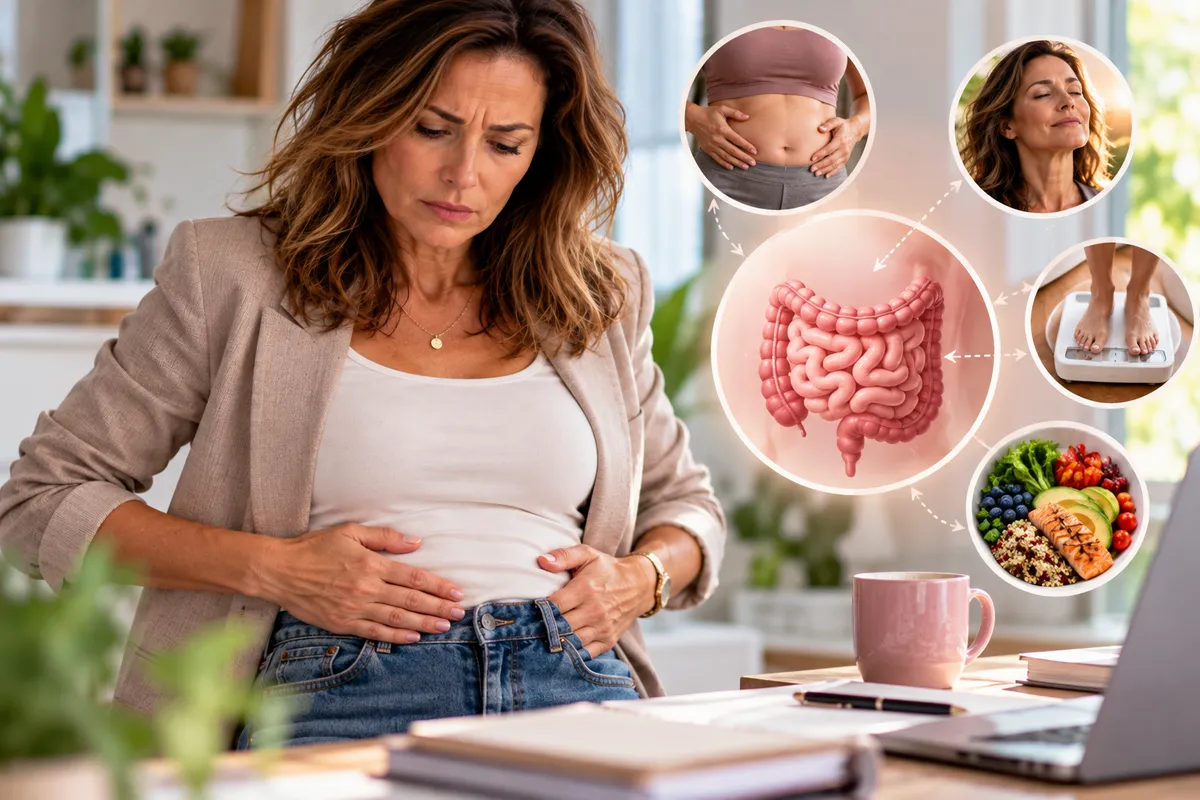
Gut Health and Perimenopause: The Missing Connection Behind Bloating, Mood, and Weight
Gut Health and Perimenopause: The Missing Connection Behind Bloating, Mood, and Weight
“Why does everything I eat suddenly make me bloated?”
This is something I hear from women in perimenopause all the time.
Foods you tolerated for years suddenly leave you uncomfortable. Your stomach looks flat in the morning and six months pregnant by dinner. You're more constipated than you used to be. Your digestion feels unpredictable.
And at the same time, other things are changing too.
Your mood is different.
Your sleep isn't great.
Your waistline is expanding.
Your energy is dropping.
You're craving foods you never used to crave.
Naturally, most women assume it's all hormones.
Hormones certainly matter during perimenopause—but your gut deserves a seat at the table too.
From a functional wellness perspective, I don't look at your digestive system as something separate from the rest of your body.Your gut interacts with your hormones, immune system, metabolism, brain, and even the way your body processes and eliminates estrogen.
So if you're trying to feel better during perimenopause but ignoring your gut, you may be overlooking an important piece of the puzzle.
Why Can Your Gut Change During Perimenopause?
Your digestive system doesn't exist in isolation.
Estrogen and progesterone can influence gastrointestinal function, and the hormonal fluctuations of perimenopause may coincide with changes in bowel habits, bloating, motility, and how your digestive system feels from one week to another.
But hormones aren't the only factor.
Think about what often happens in a woman's 40s and 50s.
Stress increases.
Sleep gets worse.
Meals become rushed.
Exercise patterns change.
Medications may be added.
Alcohol may become a nightly way to unwind.
We eat while working, standing at the kitchen counter, driving, or answering emails.
And many women have spent years cycling through diets.
Low fat.
Low carb.
Keto.
Fasting.
No gluten.
No dairy.
Another cleanse.
Another supplement.
Your gut experiences all of this too.
Then one day you notice that you're bloated after meals, constipated for days, uncomfortable in your clothes, or suddenly reacting to foods you've eaten your entire life.
That's when I want to ask more questions instead of simply saying,“It's perimenopause.”
Your Gut and Your Hormones Actually Communicate
This is one of the most fascinating parts of the gut-hormone connection.
After estrogen has done its job, the body processes it, including through the liver, and estrogen metabolites can be excreted through the digestive tract.
Your gut microbiome—the community of microorganisms living in your digestive system—can influence estrogen metabolism. Researchers sometimes refer to the collection of gut microbial genes involved in estrogen metabolism as theestrobolome.
You don't need to remember that word.
What matters is this:
Your gut participates in how your body handles estrogen.
Bowel regularity matters too.
If you're chronically constipated, that's worth addressing rather than considering it a minor inconvenience.
But I also don't want women to hear this and immediately buy a “hormone detox” or start taking five new supplements.
Gut health is more complicated than that.
We need to look at the basics first.
Are you getting enough fiber?
Are you drinking enough water?
Are you eating a variety of plant foods?
Are you moving your body?
Are you chewing your food?
Are you constantly eating under stress?
Are your bowel movements regular?
Do you have reflux, bloating, gas, diarrhea, constipation, or abdominal discomfort?
These seemingly simple questions can tell us a lot.
Your Gut Can Affect More Than Your Stomach
This is where things become especially interesting.
Your gut and brain communicate constantly through what is often called thegut-brain axis.
That's one reason digestive health and emotional health shouldn't always be viewed as completely separate issues.
If you're experiencing bloating along with anxiety, irritability, brain fog, poor sleep, or fatigue, I don't automatically assume the gut is causing all of those symptoms.
But I also don't ignore the gut.
The same is true for weight.
There is no single “bad gut bacteria” responsible for perimenopause weight gain.
Weight regulation is influenced by many factors, including hormones, sleep, stress, food intake, activity, muscle mass, insulin sensitivity, medications, genetics, and metabolic health.
But your gut microbiome is also involved in metabolism, inflammation, and the way nutrients and compounds from food are processed.
And there's another practical issue:
When your gut doesn't feel good, your eating habits often change.
You may start eliminating more foods.
You may avoid fiber because it makes you bloated.
You may skip meals.
You may become afraid to eat certain foods.
Or you may spend hundreds of dollars on probiotics, digestive enzymes, powders, cleanses, and supplements without knowing what you're actually trying to fix.
That's where the functional approach can be different.
Instead of asking:
“What probiotic should I take?”
We ask:
“Why isn't your digestive system functioning the way it should?”
Don't Just Treat the Bloating—Look for the Pattern
If your stomach is bloated every night, your body is giving you information.
The goal isn't to panic.
The goal is to get curious.
When does the bloating happen?
Immediately after eating or several hours later?
Does it happen with every meal or only certain foods?
Are you constipated?
Do you have diarrhea?
Do you feel full very quickly?
Do you have reflux?
Did the symptoms begin after an illness, antibiotics, major stress, travel, or a significant change in your diet?
Are you getting enough fiber and fluids?
How is your sleep?
How much stress are you carrying?
Are you taking medications or supplements that could be affecting digestion?
Depending on the individual and the severity of symptoms, sometimes further medical evaluation or testing may also be appropriate.
And this is important: persistent or severe digestive symptoms shouldn't automatically be blamed on perimenopause. New or concerning symptoms—such as blood in the stool, unexplained weight loss, persistent vomiting, significant abdominal pain, anemia, or major changes in bowel habits—should be evaluated by a healthcare professional.
For many women, however, the first step is simply recognizing that the gut may be part of the bigger picture.
Your bloating may not be “just bloating.”
Your constipation isn't something you necessarily have to accept.
And buying another probiotic without understanding your symptoms may not be the answer.
Start by Finding Out What Your Gut Is Telling You
One of the things I teach women is to stop looking at symptoms one at a time.
Your bloating, bowel habits, energy, cravings, mood, and other symptoms can create patterns.
And those patterns can help us decide where to look next.
That's why I created my Gut Health Assessment inside Thrive Nine.
It's a simple way to take a closer look at how your digestive system is functioning and identify areas that may need more attention.
If you're a busy professional woman in perimenopause dealing with bloating, constipation, digestive discomfort, mood changes, stubborn weight, or simply feeling like your gut isn't working the way it used to, this is a great place to start.
Take the Gut Health Assessment in Thrive Nine and see what your gut may be trying to tell you: https://phh.thrivenine.life/
Because sometimes the symptom you're most frustrated with isn't where the story begins.
Elena Levy
Functional Wellness Practitioner
Personalized Holistic Healing
personalizedholistichealing.com